Vintage Art on Wood Stick People Houses on Hills Alphabet at Bottom

"storyDirectUrl"
23 young artists you should know
 Premium
 They are creating original, bold works, are constantly evolving, and they are all below 40
In that location is no easy way to understand the phenomenon that is Indian contemporary art—and while an artist's age may take little to do with information technology, information technology is oft among the young artists, tucked away in residencies or working solo in studios, that we come across conceptual analyses, experiments with procedure, innovation with material, and cultural engagement, all of which makes Indian contemporary art terribly interesting. From an creative person currently in Beirut, wondering how art tin produce itself, to the boyfriend behind the Adarsh Balak phenomenon, from a adult female whose artistic project includes growing vegetables, to an artist who prefers to use only natural cloth for her work—the men and women we introduce you to in this piece are working in wide and varied idioms. Many of these artists take not nevertheless sold a slice of work; a few amid them split the works they sell from the art they make. Some accept non yet shown in a gallery. What they do have in common is that they are all below 40, and cannot merely call up about the earth and express it in new and heady means that evolve constantly.
To run into some of the artwork please get to the slideshow
The upcoming faces of Indian contemporary art

Pallavi Paul, 29: Paul is working on a three-channel film titled 'The Dreams Of Cynthia', a semi-documentary about a fictional post-industrial town. Working primarily with videos and the installation form, Paul says her work usually deals with philosophical questions that surround the concept of non-fiction. Ramesh Pathania/Mint

Tanya Goel, 31: Abstract painter Goel'due south works are a record—in physicality as well as metaphorically—of the disappearing as well every bit emerging architectural filigree of the city. Her work (priced between Rs20,000 and Rs 9 lakh), studies intensely the inter-relationship betwixt color and light. Ramesh Pathania/Mint

Hardeep Pandhal, 31: Pandhal, a 2d-generation British denizen of Indian descent, has been tackling the theme of his south Asian identity in his work. Pandhal, whose works include drawings done in the style of satirical political cartoons from the "Resistance Through Rituals series, is likewise taking function in the Colombo Art Biennale, which began on three December.

Hardeep Pandhal's work in collaboration with his female parent, Davinder Kaur Pandhal.

Aarti Sunder, 29: According to Tara Lal and Mortimer Chatterjee, Sunder'south "use of drawing and video in performative modes marking her out as one of the most interesting voices in the gimmicky Indian art scene. Sunder'due south works also include writings. Indeed, she finds that the medium or form follows the concept
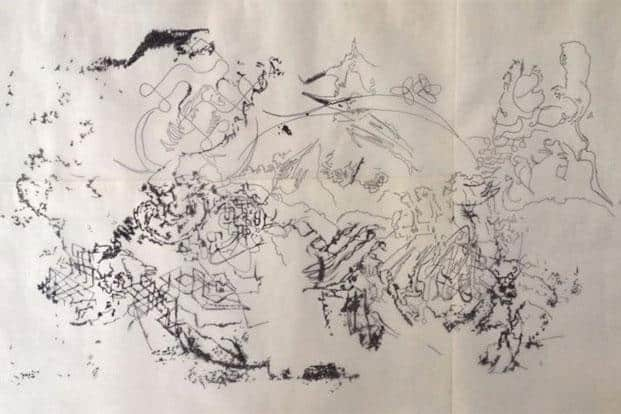
A cartoon by Aarti Sunder.

Parag Sonarghare, 30: Sonarghare has been trained as a painter at the Government Chitrakala Mahavidyalaya earlier graduating in fine art history from Maharaja Sayajirao University of Vadodara in 2010. His oeuvre is an affiliation of performance and canvas, and defies easy categorization. Sacheen Khawle

Untitled: past Parag Sonarghare

Hemali Bhuta, 37: Space has always been a crucial aspect of Hemali Bhuta's piece of work. "My try in current practice is to explore the idea of a hybrid space, in between the studio and the gallery, in between randomness and composition and, near importantly, where the course ceases to become space, she says. Aniruddha Chowdhury/Mint

Pratap Morey, 35: There is a sense of fury in Pratap Morey's appointment with the urban center, and this spills over to his piece of work. Along with photographic documentation, he developed his visual linguistic communication through the architectural element in his drawings and engravings, which sell upward of Rs50,000. Abhijit Bhatlekar/Mint

Sumakshi Singh, 36: The question of how people "run into, says Sumakshi Singh, "with their eyes, with their bodies in space, with their minds, is primal to her work. Over the years, her creative questions seemed to have shifted from the infinite which we experience every bit "identify, to the spaces inhabited more subtly, "spaces of memory, conditioning and imagination.

I of Sumakshi Singh's piece of work

Tanya Goel, notation in ten, y, z, 2015,

Prabhakar Pachpute, 30: Pachpute's works had been exhibited at the 2016 National Gallery of Modern Art in Mumbai, where his wall drawings of miners and other working class men was accompanied past a end-animation video slice. Besides charcoal, he works across a range of media, including terra cotta fibre-glass and even paper pulp. Aniruddha Chowdhury/Mint

Rohini Devasher, 38: Devasher, ane of the more prolific contemporary artists in Republic of india today, won the Inlaks Fine Arts Award twice in a row (2007, 2008) and also the Fine art Bharat Skoda Breakthrough Artist award. Devasher explores the overlaps between scientific discipline, biology, engineering science and cyberspace. Priyanka Parashar/Mint

Asim Waqif, 38: An architect past preparation, who as well occasionally lectures at the School of Planning and Architecture in New Delhi, Waqif's art exercise stems from his interest in the congenital environment and how it influences people. Some of his works over recent years make employ of reclaimed material, from construction sites as well every bit trash found on site. Ramesh Pathania/Mint

Acid on acid

Parul Gupta, 36: The line is Gupta's visual language, her artistic medium. The exploration of space through the medium of a line is taking her conceptual art, which can be priced between Rs50,000 and Rs5 lakh, in varied directions. Ramesh Pathania/Mint

Hairfall

Dheer Kaku, 27: Trained every bit a painter, Kaku's interest lay in the basics and bolts of digital media, long-exposure photographs, sensors, video-editing. One of the more than interesting fine art pieces that Kaku fabricated was shown at What Virtually Art? held in Bombay last twelvemonth. It was a sensor-activated video installation, which would alter screens each time a viewer passed by. Abhijit Bhatlekar/Mint

Shweta Bhattad, 31: Bhattad, whose fine art is rooted in agrarian communities, has a masters in sculpture from Vadodara'due south Maharaja Sayajirao University. She constantly refers to her piece of work every bit art performances and refuses to be held hostage by medium. Fine art'southward potential lies more in the concept and the questions it raises, she says.

Shweta Bhattad performing 'Exercise the Glorified Rape Scenes in Movies Inspires you to Rape'. Lalit Vikamshi

Paribartana Mohanty, 34: Having trained as a painter at the Dhauli College of Art and Crafts in Odisha, Mohanty'southward early torso of piece of work was oil portraits. Over the years, his video and performance works take started to explore the thought of a crisis, how we sympathize ourselves through our response to it. Nithin RK

Paribartana Mohanty performing 'Act The Victim' with Inder Salim.

Prajakta Potnis, 36: Capitalism, the bear upon of state of war, environmental degradation, genetically modified food, the loss of privacy, the works of Potnis, who did her MFA from Sir JJ School of Art in Mumbai, are inherently derived from gimmicky fears and anxieties. Aniruddha Chowdhury/Mint

Madhu Das, 29: This graduate from the Karnataka Chitrakala Parishath in Bengaluru engages in the human being condition in terms of public and private space, the constitution of borders, and the manner people collaborate with space. Das, who is a winner of the Inlaks Fine Arts Award in 2015, has as well been selected as visiting artist at Harvard University's South Asia Constitute. Abhijit Bhatlekar/Mint

Madhu Das with i of his artwork.

Benitha Perciyal, 36: Born in Tiruvannamalai, Tamil Nadu, Benitha Perciyal's origins seep into the cloth she chooses to work with. "I don't remember (using) annihilation plastic till I came to the urban center, says the artist, who uses only natural substances similar coal, sand, leafage, incense and seeds, among other things, to create her art installations. SaiSen/Mint

A piece past Benitha Perciyal. SaiSen/Mint

Priyesh Trivedi, 26: The immature homo backside the 'Adarsh Balak' phenomenon didn't train as an artist, or go to fine art school—his technical grooming lies in animation motion picture-making and game blueprint. The series centred around, Adarsh Balak—the ubiquitous male child common to educational posters on moral science, but indulging in activities that were decidedly not-ideal, thus offering an incisive critique of socio-cultural expectations. Aniruddha Chowdhury/Mint

Shreyas Karle, 35, Mumbai: Borders are passé as far as Shreyas Karle is concerned. Information technology shows in the fluidity of formats he uses—illustration, collage, video, sculpture and community projects—that "visually harness applesauce and social puns that smooth light upon more serious psychological issues and situations as a biography on the Project 88 gallery website puts it. Aniruddha Chowdhury/Mint

Manish Nai, 36: Mumbai-based Nai has had two solos—at Boston's Kavi Gupta Gallery and the Paris outpost of Galerie Karsten Greve. Nai's compression pieces, made with threads of jute softened with mucilage and compressed into shapes in wooden moulds, are well-known. Nai's attending to procedure and technique is remarkable, whether of unthreading jute, or applying estrus to prints, or even in the digital processes of making his works. Dinesh Parab

Sahej Rahal, 28: There'southward a fictional narrative that runs through Sahej Rahal'southward body of piece of work. A graduate of the Rachana Sansad in Mumbai, Rahal had a historic start, receiving the Forbes Award for Debut Solo Bear witness in 2014. Using found objects "that have a lived history in the world we inhabit, from a spoon to industrial debris, he creates large creatures in his installations. Ramesh Pathania/Mint
❮ ❯
To make this list, we also consulted four fine art experts: Meera Menezes, a Goa-based art writer and critic; Roobina Karode, director and chief curator of the Kiran Nadar Museum of Fine art in New Delhi; gallerists Tara Lal and Mortimer Chatterjee, who run Mumbai's Chatterjee & Lal contemporary art gallery; and Priya Jhaveri, director of the Bombay-based Jhaveri Contemporary.

View Total Prototype
Aarti Sunder, 29, Chennai
One of the widely accepted signposts of contemporary fine art is an artist's deep conceptual engagement, through which innovative means of seeing the earth emerge. As you read this, Aarti Sunder, who is at a nine-calendar month residency at Ashkal Alwan—The Lebanese Association for Plastic Arts in Lebanon, is thinking almost art, its language, and how self-reflexivity can exist made intrinsic to information technology. "My project is to look at how art tin produce itself," she explains in a conversation over Skype from Beirut. "Where does contemporary art limit itself as a method of office, how tin can art think about itself through this lens (of self-reflexivity), then come up with something that information technology can utilise to construct itself?" she adds.
According to Tara Lal and Mortimer Chatterjee, Sunder'southward "use of cartoon and video in performative modes marking her out as one of the most interesting voices in the contemporary Indian fine art scene". Sunder's works likewise include writings. Indeed, she finds that the medium or class follows the concept.
The Chennai resident studied at Mumbai's Rachana Sansad university of fine arts and craft and, later on, at the Netherlands' Dutch Art Establish. Earlier this year, she was one of the artists in residence at the International Studio & Curatorial Programme in Brooklyn, Usa, after receiving a fellowship from the Inlaks Shivdasani Foundation. Sunder has been working on a project titled Drawing On A ane:1 Scale for two years. "I take attempted to articulate ideas around the personal and the universal, the subjective and the objective and the overlaps that are created. Each version of work produced nether this title attempts to accost these ideas from a unlike angle, and using different mediums, including functioning, video, drawings, sound and text."
Sunder points out that the fine art market is no longer virtually the gallery, but besides includes publications, funding and residencies—"a market for not getting paid"—and that she is "nowadays in some form within this".

View Full Prototype
Prabhakar Pachpute, xxx, Pune
Prabhakar Pachpute spent part of his childhood in Sasti, the small village in Maharashtra's Chandrapur commune where he was born. By the time he left the village to pursue high school in the neighbouring town of Rajura, some 9km abroad, the landscape of his youth had transformed. Mining companies, which outset came to the village and its surrounding areas in the 1980s, bought farmland from the residents, including the Pachpute's family unit. In render, they were given jobs as coal miners. By the fourth dimension Pachpute left for Rajura, the village was surrounded past mines—the fields growing cotton, jowar and seasonal crops had all but vanished, says the artist.
After graduating from the Maharaja Sayajirao University of Baroda, Pachpute assisted artist Tushar Joag and, in 2011, joined the Clark House Initiative—an artists' collective which comprised Sachin Bonde, Nikhil Raunaq, Rupali Patil, Yogesh Barve, Poonam Jain and Amol Patil besides curators and co-founders Sumesh Sharma and Zasha Colah. Besides the thought-provoking conversations, Pachpute establish the "equality between curator and artist, refreshing". Within a collective, each artist would help the other out.
I of Pachpute'due south more than memorable exhibitions was at the Clark Firm space in Mumbai—human-scale drawings of coal miners on the walls, site-specific installations with establish objects, and an innovative use of light and darkness informed this exhibition. These and other wall drawings, says Roobina Karode, "bring out the subsuming of the individual into the larger labour forcefulness".
He exhibited at the National Gallery of Modern Fine art in Bombay in April-May, where his wall drawings of miners, farmers and other working-course men was accompanied by a stop-animation video piece, and has had several grouping shows internationally. He has too taken part in the 14th Istanbul Biennial, the Nanjing International Fine art Festival in China and the Asia Pacific Triennial in Brisbane. Over the years, he has sold paper works, drawings on sail, even an installation on a makeshift wall. His works on canvas have sold for Rs4 lakh and more.
Besides charcoal, Pachpute works across a range of media, including terracotta, ceramic, fibreglass and newspaper lurid. Lately, Pachpute has been thinking almost country that has been abandoned. "What happens to places where mining is over?" he asks.

View Full Image
Hardeep Pandhal, 31, Glasgow
Hardeep Pandhal, a second-generation British citizen of Indian descent, has been tackling the theme of his South Asian identity whilst operating in the Western art world. A graduate of the Glasgow School of Art, Pandhal is taking function in the Colombo Art Biennale, which began on iii December. This is his first international exhibition, and some of the works include drawings done in the way of satirical political cartoons, from the Resistance Through Rituals series, as well as a sock with a mitt-knitted confront fabricated past his mother. This slice is titled Bhagat Singh Draught Excluder By Mum.
Pandhal's collaboration with his mother, Davinder Kaur Pandhal, goes back to 2014, when he had his first UK solo at the Castlefield Gallery in Manchester. There, the artist showcased a work titled Baba Deep Thing By Mum, 2014—a woollen sweater that depicted the decapitated Sikh saint and martyr Baba Deep Singh, his severed head at the stop of the left arm, a encarmine sword stitched to the right.
Pandhal's engagement with constructed cultural identity informs all his works; the gap between his experience growing upwardly in the largely Southward Asian and Afro-Carribbean neighbourhood of Birmingham, and his parents' experience of existence migrants, translates into Pandhal's own understanding of himself as an artist. The artist takes on multiple and often competing histories—the colonial by, gimmicky migration, of Sikhism, and from his own life, growing up with English as his first language, while Punjabi remains his female parent's—just to question what we retrieve of as the truth. Priya Jhaveri finds his works "satirical, transgressive", proverb they "question the perception of British Asian identity".
Pandhal also annotates his works with several texts on psychoanalysis, mail service-colonial studies and folklore. Besides showing in galleries, he has been office of creative person residencies in the UK.

View Full Paradigm
Dheer Kaku, 27, Mumbai
Though trained as a painter, Dheer Kaku, by his own admission, stopped painting the moment he graduated from Rachana Sansad, Mumbai.
His involvement lay in the nuts and bolts of digital media, long-exposure photographs, sensors, video-editing—and through it all, a questioning of the way viewers see fine art. Kaku has spent the final three years being role of several residencies, including the Peers programme at the Khoj International Artists' Association in New Delhi, Space 118 and What About Art? in Mumbai, TIFA'due south Artel residency in Pune and the Heritage Hotel Art Spaces in Goa. He received the Inlaks Fine Arts Laurels in 2015, and has too assisted performance artist Nikhil Chopra.
Kaku is not represented however past a gallery, but his works have been showcased at residencies. Kaku has non sold whatsoever artwork, as all the same.
One of the more interesting fine art pieces that Kaku made was shown at the What About Art? international residency, held in Bombay's Bandra area, last twelvemonth. It was a sensor-activated video installation that would change screens each fourth dimension a viewer passed by.
"The viewer tin can never come across the artwork as it is, art volition ever be influenced by what the viewer sees," explains Kaku, who modified an open-source program that immune multiple interactions betwixt the screen, Webcam, and motility sensors. Mortimer Chatterjee and Tara Lal say this installation was a "detail highlight for us".
"Conceptually, at this stage, my work doesn't exist as a thing of beauty that can be picked upwardly as an object," says Kaku.
His latest project is a video work, made from the footage of his documentation of Chopra'south recent collaboration with Japanese Butoh artist Yuko Kaseki, among other performers.

View Full Paradigm
Madhu Das, 29, Bombay
After he graduated from the Karnataka Chitrakala Parishath in Bengaluru, a main's in fine arts was not height of the heed for Das—though he did one in Hyderabad a couple of years afterward. What was important to him was to find a place to paint. "After five years of working and living out of a studio, the mean solar day subsequently graduating, information technology no longer belonged to me." His choice of identify was an odd one—an abandoned water tank in Chitradurga commune, 150km from Bengaluru and famous for its 18th century fort. Freed from the walls of a studio, Das began his journeying of thinking about the human condition in terms of public and private space, the constitution of borders, and the way people interact with space. He went to Vadodara and took part in the Sandarbh residency in which, once over again, his work was pivoted on the mode people interact with art in public spaces—he photo-documented 300 trees which had been physically transformed because of the metal guards placed effectually them. He and then displayed the photos inside a muzzle-like stand, and carried the installation around Vadodara, using it to engage and interact with the public. For Mortimer Chatterjee and Tara Lal, Das' about significant brandish to engagement was at the TIFA Working Studios, Pune, "where he produced piece of work in a range of media, including a site-specific installation using a stack of wooden blocks seemingly surmounted past a whirring fan. It was a stand up-out work." Das attended the Sethusamudram artist residency in Colombo in 2010, participated in the Kochi-Muziris Biennale in 2012 and won the Inlaks Fine Arts Award in 2015. Das has also been selected as visiting artist at Harvard University's South asia Constitute—he leaves in March. Since 2013, Das has been working on a photo-documentation series of votive objects, such as saris made as offering to the Ganga river, exploring their iconic, indexical and symbolic meanings.

View Total Paradigm
Priyesh Trivedi, 26, Mumbai
Priyesh Trivedi didn't train equally an artist, or go to art school—his technical grooming lies in animation film-making and game design, and he worked in the gaming and animation manufacture for four years afterward graduation. Trivedi, who says he has been painting ever since he can remember, was bored and didn't experience creatively challenged. So, in May 2014, he uploaded a watercolour poster he had painted the previous year. Using the grapheme of Adarsh Balak—the ubiquitous boy in a bluish shirt and indigo shorts common to educational posters on moral science, hygiene and other subjects—he drew him sitting and rolling a joint. "Permit'southward tok", said the poster. "His caustic wit became an Net sensation in the last couple of years," point out Tara Lal and Mortimer Chatterjee. The series centred around the boy indulging in activities that were decidedly non-platonic, thus offering an incisive critique of socio-cultural expectations.
Since so, Trivedi has showcased his Adarsh Balak paintings in two group shows, sold several (unsigned) prints online, through his Facebook page, and attended 2 residencies—at the TIFA Working Studios in Pune, and recently, Gasworks in London. "Through Adarsh Balak, I got what I really wanted—to go into the gallery scene," says Trivedi. He, however, sells the original hand-painted works on handmade paper through galleries and digital prints, online—recently, Trivedi began using oil paint for this series. "Almost of the people on my Facebook page are young, betwixt the ages of xviii-24. I know what information technology's like in your starting time job, there's not much money. And so I desire to keep my art affordable."
His latest work, b-side, was a five-channel video installation that showed the connection betwixt the acid house scene in 1980s London and tribal cultures.

View Total Paradigm
Parag Sonarghare, 30, Vadodara
Parag Sonarghare was born in Nagpur, Maharashtra, and trained every bit a painter at the Government Chitrakala Mahavidyalaya before graduating in art history from the Maharaja Sayajirao Academy of Baroda in 2010.
His oeuvre is an amalgamation of operation and canvas, and defies like shooting fish in a barrel categorization. Equally a newly minted postgraduate, he received a scholarship from the ministry building of culture and attended the Khoj Peers residency programme, which resulted in a performance titled Being The Other, in which Sonarghare sat in a room surrounded by wheat flour in a spontaneous-gesture operation that stretched on for 10 days—he drew on the flooring, on the walls, fought with the flour. "My idea was to give myself to the food for 4-5 hours—sweat, tears, pilus, time. At the end, our elements were exchanged; the atta on me, me in the atta," says the artist.
Sonarghare has inserted himself into many of his paintings as well—his brightly coloured body sometimes juxtaposed against normally clad men, or surrounded by dogs, as in The Smart Contemporary (2012), or oftentimes, alone on the sail, doing a disappearing human activity such as in Imagine It Washed (2011), based on a functioning in Odisha's Raghurajpur hamlet. In his newer works, he has moved abroad from himself merely retained his focus on the body. His choice of subjects—especially in his 2016 show Portraits Of The Self, shown at the now closed Gallery Maskara in Bombay—bring the marginalized, ofttimes old, sometimes piecemeal male person body into sharp focus through hyper-realistic portraiture. Gallerist Priya Jhaveri finds these works "astonishingly powerful portraits of men—typically crouched, naked, and against the viewer with peppery optics."
"With their monumental realism, they are among the virtually brutally honest and jolting I take seen from a painter in a long time," she says.

View Full Image
Shweta Bhattad, 31, Nagpur
On seven December final year, Shweta Bhattad wore a pure white sari, got into a bury (with an exhaust fan fitted) and buried herself for three hours in Paris to describe attention to the plight of farmers in India.
This year, in May, she worked on a portrait of Prime number Minister Narendra Modi (alongside is the message, "Dear Prime Minister Please Grow in India") equanimous out of vegetables—the work was spread across 8,000 sq. ft in Paradsinga village, Maharashtra.
In 2014, she was selected to be function of the Vancouver Biennale'due south residency programme. Her project, I Have A Dream, explored fast-diminishing farming state, not just in India, but also globally.
At present she hopes to create sustainable public toilets in rural India: Her offset solo exhibition at Gallery Latitude, Delhi, in 2015 had a separate section on the bug women in India confront when they have to defecate in the open.
"Art is a lot more than something that is displayed in a gallery," believes Bhattad, "In fact, I recollect art outside the galleries has more potential and accomplish."
Bhattad, who has a master's in sculpture from the Maharaja Sayajirao University of Baroda and refers to her piece of work as fine art performances, refuses to be held hostage by a medium. Fine art'due south potential lies more in the concept and the questions information technology raises, she says.
A dandy bargain of her fine art is rooted in agrarian communities. "I come up from that sort of background," she says, calculation that many family members and friends are in the profession. "Farmers are suffering so much," she says. "I desire to apply my art to tell these stories."
According to Meera Menezes, Bhattad is an "artist who walks the talk". "Shweta is a very talented performance creative person whose practice is deeply enmeshed with the issues that farmers face up. This is no superficial posturing and her commitment can be seen in her state art projects equally well as her engagement with rural communities."

View Full Epitome
Hemali Bhuta, 37, Bombay
Space has always been a crucial aspect of Hemali Bhuta's work. "My attempt in current practice is to explore the idea of a hybrid space, in between the studio and the gallery, in between randomness and composition and, most chiefly, where the form ceases to become space," she says.
A student of interior blueprint, her agreement of infinite came early on. "My mother, an architect, and my male parent, a civil engineer, take been very instrumental in introducing me to being observant to infinitesimal details and to develop a corking/refined sense of pattern," she says, adding that her preparation helped. However, she also believes that training is not crucial to this understanding. "Shreyas Karle, my husband, can design interior spaces ameliorate than me—he doesn't work with set stencils like how we were trained to. I have learnt more from him," she says.
Her piece of work has a confusing quality, challenging the ways of the market and deceiving the audience. "I treat my work equally experiments," she says. Her recent solo exhibition Measure Of A Foot, held at Project 88 in Mumbai was a reflection of homo bear on on the landscape we alive in. "I enjoy exploring concepts that address issues of hierarchies, of geology, of materiality, of market, of ruins, of excavation, of failure, of gestures, of navigation and of exhibition," she says.
Meera Menezes admires Bhuta for her "very fine minimalist and restrained sensibility", adding that she is known for her employ of unusual materials to create sculptural works.

View Full Paradigm
Rohini Devasher, 38, Noida
Rohini Devasher is one of the more prolific contemporary artists in India today, and also much celebrated—she has won the Inlaks Fine Arts Honor twice in a row (2007, 2008), received the Sarai Associate Fellowship, and won the Fine art India Skoda Breakthrough Artist award. Since 2001, after graduating from the Winchester School of Art, England, where she did a master's in printmaking, she has also been role of multiple residencies, such as at the Max Planck Institute for the History of Science in Berlin, the Khoj Fine art+Science residency in Delhi and the Wasanii International Artists Workshop in Kenya.
Devasher explores the overlaps between science, biology, technology and the Internet. Her nearly recent exhibition, Speculations From The Field, at the Dr Bhau Daji Lad City Museum in Mumbai introduced the chemical element of speculation in the field of astronomy, and drew heavily from anarchy theory and deep fourth dimension , similar geology.
"Her current trunk of work is a collection of 'foreign' terrains, constructed by observing, recording, fictionalizing, and re-imagining objects and spaces that exist at the interface between science, nature and civilisation, perception and product," says Roobina Karode.
Conceptually and procedurally rigorous, Devasher's piece of work likewise spans mediums. Her 2006 Ghosts In The Machine, to have one instance, was a unmarried-aqueduct video that sought to explore the generative possibilities of video feedback past showcasing a phytoplankton-similar creature constructed by overlapping 165 layers of video, generated through a video-feedback loop, and so cut up and re-stitched. Besides video, Devasher too works on large-scale wall drawings, text, prints, constitute objects and works on paper. The artist makes little distinction between method and material.

View Full Prototype
Benitha Perciyal, 36, Chennai
Nature, identity and memory are fundamental to Chennai-based artist Benitha Perciyal'southward piece of work. Born in the town of Tiruvannamalai in Tamil Nadu, which is dotted with temples and surrounded past the Anaimalai hills, Perciyal'southward origins seep into the material she works with.
"I don't call back (using) anything plastic till I came to the city," says the artist, a postgraduate from the Regime College of Fine Arts, Chennai, who uses only natural substances like coal, sand, leaf, incense and seeds, among other things, to create her art installations. "I wanted to use material that was not alien to me, material that carries memories and is a office of me," she says, adding that her work is oftentimes a metaphor for her own life and transformations.
For example, her installation titled The Fires Of Faith, which was created for Whorled Explorations, the second edition of the Kochi-Muziris Biennale, drew on her Christian identity. Sculptures moulded out of special incense derived from materials central to faith and tradition, including frankincense, myrrh, cinnamon, cloves, lemongrass, cedar and bawl depict inspiration from the story of Christianity's permeation in Kerala. "The material used drives a bulletin of transformation and transcendence," she says, "I wanted to bring a sense of Kochi in some other form through this."
Says Roobina Karode, "Benitha Perciyal'south highly experimental practice emerges from her sustained engagement with materials and their unique cultural lives, and her own journey to detect the multiple facets of religion and its material manifestations."

View Full Image
Pratap Morey, 35, Mumbai
There is a sense of fury in Pratap Morey'due south engagement with the city, and this spills over to his work. Soon after his preparation in fine arts from the Vasai Vikasini College of Visual Arts (followed by a postgraduate diploma in Indian aesthetics from Bombay Academy), Morey started off as a formalist painter—from cocky-portraits on big canvases, he started working on paintings related to his firsthand world, from the ceiling fan to the corner of his studio, to the play of colours on the floor. This engagement with his environment led him to what has now become the chief business concern in his do: rapid urbanization, the resultant deportation and alienation among people, and "the enforcement of a new culture". Morey'south memories of displacement begin in his childhood in Mumbai, when his family would move every couple of years or then either considering of his male parent's transferable bank task or compulsions of rent. This has continued into his adulthood, with him constantly having to vacate his studio or home in old buildings ("all I can afford right at present") and then they tin can be broken down to brand way for the new. More starkly, he has been witness to the changing topography of the urban center, with chawls suddenly making way for "awe-inspiring" malls and a vertical city that merely creates "an illusion of space", where ane can never seem to belong. "I questioned this thought of redevelopment and the invading of individual spaces," he says. Along with photographic documentation, he developed his visual language through the architectural chemical element in his drawings and engravings, which sell upwards of Rs50,000. While his work Between The Two Voids (2015)—a dizzying view of a vertical city—recreates the feeling of a loss of residual and breach in urban environments, in his Superimpose series he makes drawings inspired by "mutual people's houses on to images of 'redevelopment' sites in Mumbai". They will resonate with every resident of an urban sprawl.

View Total Epitome
Prajakta Potnis, 36, Mumbai
A group show, Imagined Futures Reconstructed Pasts, on till Dominicus at Bikaner Firm in New Delhi, features two photo works by Prajakta Potnis which were part of her exhibition When The Wind Blows, held in January by Project 88. They bear witness staged scenarios within an quondam freezer—against the ice building up are everyday objects, pressure level-cooker whistles in i, a lighter in some other. In the photographs, the magnified scale allows a carve up narrative to unfold in the viewer's listen—an apocalyptic landscape, "of something on the verge of being blown up". When The Wind Blows was an extension of Potnis' interest in showing the connectedness between the private—through the use of quotidian objects—and the political. The title of the testify itself was derived from a graphic novel from the 1960s, which deals with the fear of the cantlet bomb. "The fright is even so there, and information technology's fifty-fifty scarier with (United states of america president-elect) Donald Trump," says Potnis. The series was inspired by "The Kitchen Debate", a "hilarious, heated debate between (Ronald) Reagan and (Nikita) Khrushchev in forepart of a washing machine, at a time when the US was trying to bear witness off their modern kitchen appliances to the Communist world. It was like watching two fiddling boys fighting, each propagating their own ideology," says Potnis. Capitalism, the impact of war, environmental degradation, genetically modified food, loss of privacy, the works of Potnis, who did her primary's from the Sir JJ School of Fine art in Bombay, are inherently derived from gimmicky anxieties. Then, if a still-life painting of a cauliflower takes on the class of a mushroom deject, in site-specific works she developed the idea of the wall as "a membrane between the inside and exterior space". From hanging threads giving the perception of cracks to keyholes drilled in walls or frills hung equally skirting to give the impression of a drapery—opaque spaces appear "fragile, giving the sense of being watched".

View Full Image
Manish Nai, 36, Mumbai
Bombay-based Manish Nai has had a hectic by few years. When we last met him at the opening of his show at Studio-10 (in 2014), he was preparing for the second edition of the Kochi biennale, as well every bit a solo testify at Galerie Karsten Greve in St Moritz, Switzerland. In the past year, he has had 2 solos—at Chicago's Kavi Gupta Gallery and the Paris outpost of Galerie Karsten Greve. On 10 December his works were part of an exhibition curated past Girish Shahane, at a collateral effect of the ongoing Kochi biennale. Nai'due south compression pieces, made with threads of jute softened with glue and compressed into shapes in wooden moulds, are well-known. Around 2011, Nai likewise began to take photographs of empty billboards, half-torn downwards, while travelling. Using these images of what he calls "ready gestures", he would merge them digitally. His recent works showcase close-cropped versions of these billboards.
Nai's attention to procedure and technique is remarkable, whether of unthreading jute, or applying heat to prints, or even in the digital processes of making his works.
Co-ordinate to Roobina Karode, "Manish works in a redemptive rather than radical fashion. His abiding concerns and experiments with humble materials and unusual media and with procedure aggrandize the possibilities of art rather than revolt against its basic conventions—an attitude which places his work in relation to the artists of the Arte Povera move."

View Total Image
Asim Waqif, 38, New Delhi
An builder by grooming, Asim Waqif's art practice stems from his interest in the congenital surround and how it influences people. Waqif'southward piece of work, though, is non art for art's sake; he's too actively attempting to influence the viewer, particularly on issues of ecology and sustainability. But this "activism" is delivered with a bear upon of humour.
Take, for instance, Seedbombing (2014), where organic pellets containing seeds were to be pelted at a crumbling building opposite Khoj in Delhi—"the long-term plan to infest the building with invasive creepers". Waqif says one of his aims is to bridge the gap betwixt modern and vernacular do with his piece of work, from those based on his research on water-harvesting techniques in the pre-colonial era, to sustainability. "But I felt I was getting typecast as a romantic traditionalist, when I was trying to take reward of modern science and traditional technique," he says. Recent works make apply of reclaimed material, from construction sites as well equally trash institute on site. This started at Palais de Tokyo, Paris, in the backyard of which he chanced upon discarded cloth which he reused to create Bordel Monstre. With works that allow viewer experience to exist enhanced through their interaction with information technology, Waqif also attempts to stir debate on questions of accessibility of fine art, from its commercial value to the idea of just touching artworks. "Nothing volition happen to a stainless steel piece of work by Subodh Gupta if we touch information technology. But as a work's commercial value rises, its experiential value gets curtailed," he says.
Well-nigh of his works, particularly site-specific ones, are not designed to sell, says Waqif. Even though information technology's important for him that he makes a living from art, his mischievous nature comes to the fore again when in the works that can sell—archival prints on acid-free paper, which traditional buyers admire considering they can final an age—he decides to actually use acid to suspension apart the image.

View Total Image
Paribartana Mohanty, 34, New Delhi
Having trained as a painter at the Dhauli College of Fine art and Crafts in Odisha, Paribartana Mohanty's early works were oil portraits of individuals belonging to specific groups—for instance, a waste material collector in Found Object, Kabadiwala And Conservator, which shows a human being property a vintage camera. The photographic camera itself is now an important medium for him. In video and performance works, he explores the idea of crisis. "Crisis is a theme that he repetitively engages with, both equally an act or incident and as a psychological and emotional space," says Roobina Karode. The title of his solo prove of romanticized portraits at Delhi's Vadehra Art Gallery, Kino Is The Proper name Of A Wood, came from his visit to the house of a Swiss collector of cameras (kino in German language), where he felt similar he was inside a wood of cameras—a metaphor, he says, for contemporary life where we are surrounded by cameras. Mohanty has since stopped portraiture, bored past the demands to stick to a tried and tested structure. His contempo visit to Fukushima in Japan led him to document the radiation zone; he is at present creating docu-fiction videos on the idea of victimhood. This is an idea that he explored in his performance work, Deed The Victim. "This is related to the social and political life in India, where anybody feels like a victim, of corruption, pollution, etc." He held "auditions" where he would become people to deed out their feeling of victimhood repeatedly. "Through this repetition, I deconstructed the idea of victimhood." His collaboration with creative person Inder Salim, says Mohanty, gave it boosted meaning. Salim made Mohanty go out the manager'due south chair and acquit him on his shoulders, which not only inverted their positions of power only left Mohanty with an intense sense of humiliation. "I realized art is non separate from life," he says.

View Full Epitome
Parul Gupta, 36, Delhi
The line is Parul Gupta's visual language, her artistic medium. A commerce graduate from Delhi Academy, Gupta pursued a master'south in fine arts from Nottingham Trent Academy in the Uk. Hairfall, a video documentation of her falling blackness pilus edifice up on a white canvass over several days, forms the genesis of the thought of the line; the video fifty-fifty featured in her recently concluded exhibition, Let's Go on In Parts, at the Instituto Cervantes in Delhi. The straight line continued to remain the material with which she subsequently started to explore architectural spaces and how our bodies sympathize them. Nosotros are all performers when we navigate such a infinite, she says, with the architect as the managing director who has preconceived where we enter the infinite and where nosotros turn. "I try to break that perception, create a rupture in what we know," Gupta says. In Let'south Proceed In Parts, she elevated the flooring and as well had a pillar that disrupts our perception of the exhibition space past moving always and then slowly. In spatial drawings, using lite against thread, she allows viewers to move into information technology through the shadows created, in an try to break the notion of a cartoon as a still object. In her site-specific work at the Sarai Reader 09 bear witness at the Devi Art Foundation in Gurgaon, she says her try was to answer to the given infinite rather than occupy it. The exploration of space is taking her conceptual art, which can be priced from Rs50,000 to Rs5 lakh, in varied directions. In one of her contempo performative pieces, she gave herself instructions: Sit in a room and work from 10.30am to 5.30pm for x days. The idea was to explore how programming works on the brain and the tussle between the conscious and subconscious mind—when tired or in pain, Gupta found her conscious mind urging her on. She made a 22ft drawing in five parts. "It was to question the idea of a collection. And then each collector will only have a part of the work, never the whole."

View Full Paradigm
Shreyas Karle, 35, Mumbai
Borders are passé as far as Shreyas Karle is concerned. It shows in the fluidity of formats he uses—illustration, collage, video, sculpture and community projects—that "visually harness absurdity and social puns that shine low-cal upon more than serious psychological bug and situations" as a biography on the Project 88 gallery website puts information technology. His creations are ofttimes a tongue-in-cheek interpretation of common objects. For case, Fountain, the artwork he showcased at the Kochi-Muziris Biennale 2012, showed the futility of human'southward effort to tame h2o—the h2o leaked from a tube beneath the fountain instead of gushing from its rima oris.
An education in fine arts was always at the back of his mind, he says, "since I had closely seen my cousin's college life in an fine art school in Bandra (Mumbai)". The artist, who holds a chief's in visual arts from the Maharaja Sayajirao University of Baroda, says, "Since I got into an art college straight after my class X, I was considered a failure in the mainstream education arrangement."
Drawing a parallel between mainstream educational activity and the gimmicky fine art system, he says, "The problem is not the system but the beholders of the system who accept created a belief/lodge of things. It continues to decadent itself and the gatekeepers of the organization continue to celebrate the flaws in information technology."
Karle is the co-founder of CONA Foundation, an alternative artist infinite in Borivali, Mumbai.
One of Karle's and his wife Hemali Bhuta'south more contempo projects was Bartered Collections or Len Den, in which they invited artists to participate in a barter of works, setting their ain terms for the deal, and thus challenging the idea of value every bit currently defined past the art market.
Talking about the space, Karle says, "We don't call it a collective—we are just individuals who come in and go out complimentary-flowingly as per our needs and availability. We have no set rules, no set structure, perhaps no permanent space also. That'due south how our programmes evolve too."

View Full Image
Tanya Goel, 31, Delhi
Tanya Goel captures within her frames the flux and chaos of the post-industrial urban landscape in which she has lived her 3 decades—a resident of Delhi, she also lived for a time in the Usa while doing her master's from the Yale University School of Fine art. The abstruse painter's works are a tape—in physicality every bit well every bit metaphorically—of the disappearing as well as emerging architectural grid of the metropolis. "Cities are a flux of activity, additions and erasures of intentional/unintentional grids," says Goel. Co-ordinate to Roobina Karode, "Tanya's magnificent paintings ... evoke the calculated chaos of a city with its lights, noise, and colours, (and) her work inspires recognition of the idiosyncratic complexity of the urban fabric." The artist goes through an elaborate process of collecting material from construction sites, which is broken down into pigments or colour data, which and then serve as an archive of the buildings that are to be erased from the map. For her prove Levels at Galerie Mirchandani + Steinruecke in Mumbai this year, for example, she collected debris similar cement, brick, glass, fe and dust from houses built in the 1950s. "These structures are chop-chop disappearing, to be replaced by newness," she says. The geometrical grids of her works underline her consciousness of a earth that she says she understands through the "presence and absence of lines, the contours they define and the shape they enfold". The creative person, whose works are priced anywhere from Rs20,000 to Rs9 lakh depending on their calibration, studies intensely the inter-relationship betwixt colour and calorie-free. "It is our disability to hold low-cal that interests me most about it. Colour transmutes from light to surface, from matter to material, it interferes, blurs and informs the visual and psychological associations we make within our everyday. Colour is 1 of the most challenging phenomena, because the minute it occurs, information technology changes. In my work, I expect at colour equally material, and light as fiction that plays on that cloth surface." Her current research, she mentions, is on pigments made from aluminium and charcoal, "both highly toxic and aesthetic at the same time and yet a very integral part of our lives".

View Full Image
Minam Apang, 37, Goa
Minam Apang is media-shy, and refused to speak to us when we called her. The prolific artist, who is well regarded internationally, participated in the Prague Biennale of 2011, received the Civitella Ranieri Foundation, Italia, fellowship in 2013, and has had exhibitions at the Hara Museum of Art in Tokyo, and at the triennale at the New Museum in New York (curated past Eungie Joo). Apang's intricate drawings on cloth and paper are typically made with charcoal, acrylic, graphite, and, occasionally, cola, and reference her multiple contexts. In a 2008 creative person statement that accompanied her exhibition War With The Stars, which derived from origin myths, Apang wrote: "Much of my work draws from a feeling of dislocation and the need to make sense of the many contexts I have come to occupy. I went to school in Mussoorie, with a distinctly Christian upbringing. I would come home to Arunachal, where we follow 'pagan', animistic practices and tribal rituals. The ii conventionalities systems were, on the surface, very disparate. The contradiction has been something I have wrestled with and tried to make sense of for a long time. Much of my works are an expression of this process of reclaiming my own sense of location. The disconnected, non-linear dream vocabulary of myths and folktales offered me a form of expression ideally suited to my hybrid teleology." The creative person has worked with graphic design reminiscent of pop art, and acrylic on canvas. Her works are priced between Rs4-8 lakh.

View Full Prototype
Pallavi Paul, 29, New Delhi
In 2014, Pallavi Paul began reading a work by poet Jack Spicer which consisted of a series of impassioned, urgent letters to another poet, Federico García Lorca, nearly two decades later the latter's death.
"It became a wonderful challenge for me to endeavour and create a scenario where Lorca could write back to Jack," she says, calculation, "From this point on poetry became a syntax through which I was able to look at cinema, epitome-making and agreeableness of animated futures."
A graduate in English language literature, Paul went on to graduate from the AJK Mass Communication Research Centre, Jamia Millia Islamia, Delhi, and is currently doing her PhD at the School of Arts and Aesthetics at Jawaharlal Nehru University. She is also working on a 3-channel picture titled The Dreams Of Cynthia, a semi-documentary about a fictional post-industrial boondocks. Commissioned by AV Festival, UK, and Profile Biennale, Mechelen, the film is hosted past two characters whose destinies are intertwined past the ascent of this town and its eventual turn down.
Working primarily with videos and the installation grade, Paul says her work usually deals with philosophical questions that environment the concept of non-fiction. "In other words, it is the theatre of factuality or the fact itself that I am interested in as an observer also as an artist," she says, adding that these regimes of fact or truth production offering insights into how fourth dimension is structured and how things are remembered and archived.
"Obviously, engineering is very important in all this because of the way it constructs our ideas of infinite, time and the possibilities of the future," she says.
Paul's work is particularly interesting, according to Roobina Karode, because "using the disruption between 'reality image' and 'documentary' as a starting point, she attempts to create a laboratory of possibilities which test the contours of fantasy, resistance, politics and history".

View Full Image
Sahej Rahal, 28, Mumbai
In that location's a fictional narrative that runs through Sahej Rahal's body of work. Or rather, as he says, he's "substantially expanding mythology in which fictional civilizations are unfolding in our reality". A graduate of the Rachana Sansad in Mumbai, Rahal had a celebrated start, receiving the Forbes Award for Debut Solo Show in 2014. Using found objects "that accept a lived history in the world we inhabit", from a spoon to industrial droppings, he creates large creatures in his installations. He himself will describe them with glee as "weird", "cool" , "scary nightmares", with which he wants people to collaborate. It's a more productive mode of appointment with history than if it were to seem that the artist was imparting cognition, he says. "Within this narrative, these beings perform absurd acts in derelict corners of the city, transforming them into liminal sites of ritual," says Roobina Karode. Rahel, who considers writer Jorges Luis Borges a guru—essentially for the way in which he cocks a snook at readers—is driven past a sense of fun. For example, he created a didgeridoo out of a PVC pipage and performed with it. He direct references the flick series Star Wars in some works, as much for the fact that it was a office of his life while he was growing up as to confront snooty notions of the canons of history that are immune to be referred to. Rahel's piece of work Frozen World Of The Familiar Stranger, which takes off from an essay on urban anonymity, is currently part of a group show at Khoj Studio in Delhi.

View Total Image
Sumakshi Singh, 36, Gurgaon
The question of how people "meet", says Sumakshi Singh, "with their optics, with their bodies in space, with their minds", is key to her work. Over the years, her artistic questions seemed to have shifted from the infinite which we experience as "identify", to the spaces inhabited more than subtly, "spaces of memory, workout and imagination". In 1 work, she recreated from memory a 3D illusion in chalk of her grandfather's living room; viewers walked about the space till the outlines got erased. Her installations—from micro-worlds and big illusions to 3D animations—which besides utilize the history of a infinite, from the flaking frescoes in Italia or a manicured "natural" environment in Chicago, are made to create an "interruption in our conditioning of how we perceive that detail space". At the 2014 Kochi biennale, her work In, Betwixt The Pages invited viewers to enter a large-scale fantastical mural; as they did so, 2D screens would testify them as characters in an illustrated manuscript. "Sumakshi'due south piece of work traverses the lines betwixt metaphor, reality and illusion and ranges from plays on space-time theories to cultural, historic and physical critiques of place," says Roobina Karode. Singh is at present working on a solo booth for the Republic of india Fine art Fair in Feb, a solo show in Ahmedabad in March and a show at the Dr Bhau Daji Lad museum in Mumbai in May. The last includes tiny paintings on plastered woods which resemble fossils and embroideries where the fabric has been removed so y'all are left with delicate, thread structures of botanical specimens.
Close
Select your Category
Your Message
No Network
Server Issue
Cyberspace Not Bachelor
Source: https://www.livemint.com/Leisure/03fuuzZ1jPvM8vhfSux1VM/23-young-artists-you-should-know.html
0 Response to "Vintage Art on Wood Stick People Houses on Hills Alphabet at Bottom"
Post a Comment